I am writing these words as a route map
an artifact for survival...
History is not kind to us
we restitch it with living
past memory forward
into desire
into the panic articulation
of want without having
or even the promise of getting.
And I dream of our coming together
encircled driven
not only by love
but by lust for a working tomorrow
the flights of this journey
mapless uncertain
and necessary as water.
-Audre Lorde
Monday, October 27, 2008

Wednesday, October 22, 2008
Until...
There are those, bright and visible among us, who believe in a Queer Renaissance...that we can make the world anew by loving transformation with our every action, by building our wishes into place to live, by writing our dreams in deep red pen on every wall that faces us. There are those among us who thread the present into 50 ways to reimagine life at once, teasing the future with incrementally wilder ways to be present. Queer black filmmaker, poet, thinker Julia R. Wallace is one of those.
I'm a fan. (Can you tell?)
As an outgrowth of the collaborative online community transformation venture Queer Renaissance (www.queerrenaissance.com), and a compelling poetic filmic vision, Julia Wallace is creating Until, a poem crystallized into a short experimental narrative film about friendship, love, secrecy, shame and the possibility of freedom. And I want you to know about it. Because I love you.
After hearing the poem and reading the screenplay for Until I already have a crush on the main character. Pro, a quiet loving earnest college student wants the best for her best friend Hailey. And she's thrilled and gratified when after facing rejection from some guy on campus, Hailey wants her. As always though, it gets complicated when the lights turn on. What will it take for each woman to be true to herself in private and in public?
Y'all, reading this screenplay makes me want to be a better braver person. It scrapes up those moments when we choose our fears over each other, and when we choose each other out of fear...it makes me want to build altars and monuments to those public hand holdings and private yeses that risk everything except our integrity. And to those moments when we almost get there.
There should be a billion films like this, but there aren't, and Julia and the crew are shooting November 14-16 in Atlanta so go here to find out more about Until and how you can support that necessary process of making our love, our questions, our hope and our process visible and tangible.
love always,
lex
Sunday, October 19, 2008
Because All Our Love Matters: State Economic Violence and the Beauty of Survival
First National Congress of Mothers: Address of Welcome, Mrs. Theodore W. Birney (1897)
Conference on the Care of Dependent Children: Call for the Conference, Theodore Roosevelt (1908)
Social Security Act of 1935: Title IV-Grants for Sate Aid to Dependent Children (1935)
Social Security Act Amendments of 1939: Old Age and Survivors Insurance Benefit Payments (1939)
"Cleveland Sends 9 Negroes South" New York Times, June 9, (1956)
Illegitimacy and Its Impact on the Aid to Dependent Children Program, Bureau of Public Assistance, (1960)
The Negro Family: The Case for National Action, Daniel P. Moynihan (1965)
"Woman Battles Sterilization Ruling," Harry Trimborn Los Angeles Times, May 31 (1966)
"47 More Negroes Held in Carolina," James T. Wooten, New York Times, November 13 (1968)
Dandridge vs. Williams, Supreme Court (1970)
"Welfare is a Women's Issue," Johnnie Tillmon (1972)
"States Abortion Law Helps Reduce Welfare Costs," Oakland Tribune, (1972)
Hearings on Health Care and Human Experimentation, Niel Ruth Cox (1973)
"Funding Sterilization and Abortion for the Poor," Sheila M. Rothman (1975)
"State of the Union Address," Gerald Ford (1976)
"Restoring the Traditional Black Family," Eleanor Holmes Norton (1985)
(All of the above can be found in Welfare: A Documentary History by Gwendolyn Mink and Rickie Solinger)
Welfare's End, Gwendolyn Mink, (1998)
Still Lifting, Still Climbing: African American Women's Contemporary Activism, Kimberly Spinger ed., 1999
especially:
"Vision Statement", National Black Women's Health Project
"'Triple Jeopardy': Black Women and the Growth of Feminist Consciousness in SNCC, 1964-1975," Kristin Anderson-Bricker
"'Necessity Was the Midwife of Our Politics': Black Women's Health Activism in the 'Post'-Civil RIghts Era (1980-1996), Deborah R. Grayson
Beggars and Choosers: How the Politics of Choice Shapes Adoption, Abortion and Welfare in the United States, Rickie Solinger, (2001)
Soul Talk, Gloria Hull (2001)
Women of Color and the Reproductive Rights Movement, Jennifer Nelson (2003)
The Politics of Public Housing: Black Women's Struggles Against Urban Inequality, Rhonda Y. Williams, 2004 (and props to Rhonda for suggesting most of this reading list)
and
Faubourg Treme (www.tremedoc.com)
www.hermanshouse.org
www.maryturner.org
www.miamiworkerscenter.org
www.poweru.org
www.takebacktheland.blogspot.com
www.jessemuhammed.blogspot.com
www.2-cent.com
and especially Prisons as a Tool for Reproductive Oppression: Cross-Movement Strategies for Gender Justice
Remarks of Gabriel Arkles from Sylvia Rivera Law Project on panel at CR10, 9/27/08
let me start with an excerpt from an email I wrote the other night:
predictably, becoming a 48 hour expert on welfare in the US has made me really really angry.
it's crazy how brutal and extreme the implications of US welfare policy are. the whole set of laws and the political speeches that endorse them are written to make black motherhood a crime and to make the production or sustenance of black life false value, unvalue, negative possibility.
like the federal government funding sterilizations at a 90% rate and abortions only at the rates that the states do (so at the most 50% in the 1970's
or this woman literally going in to jail because she refused to undergo a sterilization she was sentenced to in court for the minor charge or being in a room where she knew marijuana was being consumed.
never meant to survive. never even meant to be born.
but then the miraculous thing is how we keep doing both those things anyway, persistently reborn regardless...
like Martha Benton a black mother who as the leader of a second generation of black women organizing for their right to public housing in Baltimore says of her mentor Goldie Baker "I am her creation."
and like the sisters at what was National Black Women's Health Project and Sister Care and other sustainable health collectives for black women saying "necessity was the midwife of our politics"
and like the women who founded the Georgia Hunger Coalition who I literally saw chant down the evil EBT/food stamp policy makers at the Jimmy Carter Library when I was 18
and like Rosemarie Mitchell at Low Income Families Fighting Together who told me last weekend that her 7 years working for LIFFT is the pursuit of happiness made real even though she cries late at night sometimes
or like Paul Newman, one of my students/adopted siblings who read a poem to a crowd tonight while shaking from nervousness and the chill in the air about how the school to prison pipeline is doing everything to steal his life but how he's a superhero so it can't destroy him.
So anyway. I'm gonna be here tonight writing about it.
because all our love matters,
lex
All our love matters. Neoliberalism be damned.
My reading up on welfare policy and politics in the United States has me wishing I was reading slave code instead.
We have all heard the myth of the welfare queen, having babies 5 or 6 IN ORDER to be poor enough to steal assistance from the government. Some of us have heard that myth over and over again for decades. That is the myth that allowed politicians (most notably Reagan and Clinton) to screw over poor women and children of all races in the United States over by dismantling welfare piece by piece. Somehow repetition got voters to believe that most of the people on welfare to believe that some scandalous black woman with a brood of kids was the typical welfare recipient. To forget that most of the people on welfare have always been white and that (according to the Bureau of Public Assistance itself) only half of one percent of mothers on welfare even have more than 5 kids. And, according to government stats again, most mothers on welfare don't have any kids while they are on welfare and the overwhelming majority of mothers on welfare only have one or 2 kids at all.
But somehow we are all told this story. Poor black young women have kids to cheat money from the US government. Which means that poor black children (and poor children generally) are not only worthless, they create negative value and negative values at the same time. How dare these black women pretend tha the lives of their children are valuable enough to make their survival a community concern. The nerve.
Of course we are hearing the same story about the children of immigrants now. People are coming to the United States to have their children in order to steal benefits, cheating into a citizenship that was never meant to value the lives of the children of those forom the countries that the United States destablizes for economic gain.
This mundane every day set of racist stories teaches, and makes normal the most deadly, inhumane and disgusting lie that has ever been told:
Some lives are worth less than nothing. At birth.
Which of course means, some people should be prevented from being born.
If the denial of benefits to children in need wasn't disgusting enough to someone reading this, please remember that these policies are in bed next to the targeted prevention of certain people's lives from the outset. Gary Bauer, chief aide to Ronald Reagan (who by the way along with all of his other crimes against humanity Reagan is the person who coined the term "welfare queen") blamed the "reckless choices" of poor women who had children the cause of an apocalypse "There will either be no next generation, or there will be a generation that is worse than none at all." Representative E. Clay Shaw of Florida agreed arguing that poor women be sterilized "when they start having these babies one after another, and the terrible thing they are doing to the next generation...something has got to be done to put a stop to it."
What does that mean? "Worse than no generation at all." Whose life is worse than the absence of life on the planet? What does it mean to prefer the end of humanity to a future in which the children of poor women exist?
And everything possible was done. When Georgia and North Carolina and Florida et al failed to make compulsory sterilization a requirement for women receiving welfare, California led the move, first a jusdge sentences a woman on welfare to sterilization for a minor infraction. And the federal goverment when slick institutional violence style, using imbalanced funding to make sterilization more accessible to poor women than abortion. (see Funding Sterlization and Poor Women citation above---i wish it was just a conspiracy theory, but it's not.)
And reading all of this, I was sickened, but not surprised. As Gabriel Arkles points out prisons have an explicit policy to govern the lives of transgendered prisoners in order to "prevent pregnancy" and we know that women who give birth in prison are often sterilized at the moment they give birth under anesthesia and very shady "consent" circumstances. The state, especially a state that has sold itself to neoliberal capitalism has every reason to prevent some folks from being born, some folks from parenting...because the values we create say life is everything, and all life is priceless, our autonomy of when and how we parent is ours, because we, queer, racialized, poor, immigrant radical parents and queer, racialized poor immigrant radical youth are creating a world that is valuable without the sale of people and the enforcement of really bad ideas.
And we are born and reborn again and again. So Bauer and Shaw and so many others are afraid of the world that we ARE creating...with our youth and our rebirth and our literal birth and all the other forms of our creativity.
Be scared. Shit.
Because we are born and birthing and just these past couple of weeks I met some amazing midwives of color like Ayanfe and Anjali and some amazing mamas of color and some amazing youth of color and especially some amazing organizers committed to survival, which is the resounding counter message that our lives mean everything
because all our love matters.
now.
always,
lex
Tuesday, October 14, 2008
Hail the Birth of Quirky Black Girls Magazine!

Quirky Black Girls is a network of fierce black women. We share our dreams, visions, and thoughts with you by producing the feminist publication QBG (Quirky Black Girls) Magazine, a quarterly ezine focusing on politics, cultural criticism, and social change. QBG Magazine features our art, poetry, fiction and nonfiction, and our ruminations on popular culture and social issues.
mission
QBG Magazine aims to provide a forum for Quirky Black Girls - and those who love them - where feminist dialog is the only norm and following your truth is the the only rule.
QBG Manifesta
Because Audre Lorde looks different in every picture ever taken of her. Because Octavia Butler didn't care. Because Erykah Badu is a patternmaster. Because Macy Gray pimped it and Janelle Monae was ready.
Resolved. Quirky black girls wake up ready to wear a tattered society new on our bodies, to hold fragments of art, culture and trend in our hands like weapons against conformity, to walk on cracks instead of breaking our backs to fit in the mold.
We're here, We're Quirky, Get used to it!
.... Quirky Black girls don't march to the beat of our own drum; we hop, skip, dance, and move to rhythms that are all our own. We make our own drums out of empty lunchboxes, full imaginations and number 3 pencils.
Quirky Black girls are not quirky because they like white shit; rather they understand that because they like it, it is not the sole province of whiteness.
Quirky black girls are the answer to the promise that black means everything, birthing and burning a new world every time.
Sound it out. Quirky, like queer and key, different and priceless, turning and open. Black, not be lack but black one word shot off the tongue like blap, bam, black. Girl, like the curl in a hand turning towards itself to snap, write, hold or emphasize. Quirky. Black. Girl. You see us. Act like you know.
We demand that our audiences say "yes-sir-eee" if they agree and we answer our own question "What good do your words do, if they don't understand you?" by speaking anyway, even if our words are "bruised and misunderstood."
Quirky black girls are hot!
Whether you're ready to see it or not.
Quirky means rejecting a particular type of "value," a certain unreadiness for consumption and subsumption in an economy of black heterocapital. This means that Quirky Black Girls act independently of dominant social norms or standards of beauty. So fierce that others may not be able to appreciate us just yet.
No matter what age we are, we hold onto that girlhood drive for adventure, love for friends, independent spirit, wacky sense of humor, and hope for the future.
Quirky Black Girls resist boxes in favor of over lapping circles with permeable membranes that allow them to ebb and flow through their multiple identities.
Quirky Black Girls- Embrace the quirky!
Sunday, October 05, 2008
Combahee Survival
Check out the new Combahee Survival Project from BrokenBeautiful Press!

We were never meant to survive. None of us. We were never meant to find each other, love each other, remember the warriors that came before. We were never meant to know these histories. We were never meant to turn our trauma into a map for transformation. We were never meant to survive. But we do it anyway.
Break it down. Sur viv al. Life underneath waiting to embrace all of us. Survival is a poem written in a corner, found waiting in a basement, forgotten. Survival is when the timeliness of your word is more important than the longevity of one body. Survival is spirit connected through and past physical containers. Survival is running for your life and then running for Albany city council without consenting to the State. Survival is shaping change while change shapes you. Survival means refusing to believe the obvious. Survival means remembering the illegal insights censored in the mouths of our mothers. Survival is quilt patterns, garden beds. Survival means growing, learning, working it out. Survival is a formerly enslaved black woman planning and leading a battle that freed 750 slaves from inside an institution called the United States Military. Survival is out black lesbians creating a publishing movement despite an interlocking system of silences. Survival is a group of black women recording their own voices, remembering a river, a battle, a warrior and creating a statement to unlock the world. Survival is like that.
We were never meant to survive. And we can do even more. This booklet moves survival to revival, like grounded growth, where seeds seek sun remembering how the people could fly. We are invoking the Combahee River Collective Statement and asking how it lives in our movement now. And the our and the we are key to this as individual gains mean nothing if others suffer.
We were never meant to survive but we will thrive. We want roundness and wholeness, where everyone eats and has time to be creative has time to just be, What tools does it give that are necessary to our survival? What gaps does it leave us to lean into? Black feminism lives, but the last of the originally organized black feminist organizations in the United States were defunct by 1981.
Here we offer and practice a model of survival that is spiritual and impossible and miraculous and everywhere, sometimes pronounced revival. Like it says on the yellow button that came included in the Kitchen Table Press pamphlet version of The Combahee River Collective Statement in 1986 "Black Feminism LIVES!" And therefore all those who were never meant to survive blaze open into a badass future anyway. Meaning something unpredictable and whole.
We were. Never meant. To Survive. And here we are.
And beyond survival, what of that? In 1977 the Combahee River Collective wrote "As Black women we see Black Feminism as the logical political movement to combat the manifold and simultaneuos oppressions that all women of color face." They also said "The inclusiveness of our politics makes us concerned with any situation that impinges on the lives of women, Third World and working people." And they concluded: "If Black women were free, it would mean that everyone else would have to be free since our freedom would necessitate the destruction of all the systems of oppression."
Today we, a sisterhood of young black feminists, mentored in words and deeds by ancestors, elders, peers and babies, assert that by meditating on the survival and transformation of black feminism we can produce insight, strategy and vision for a holistic movement that includes ALL of us. So while this is a project instigated by self-proclaimed (and reclaimed) black feminists, our intention is that it can be shared and changed by everyone who is interested in freedom.
Check out the exercises, form a study group, and contribute to the Combahee Survival Zine at www.combaheesurvival.wordpress.com!
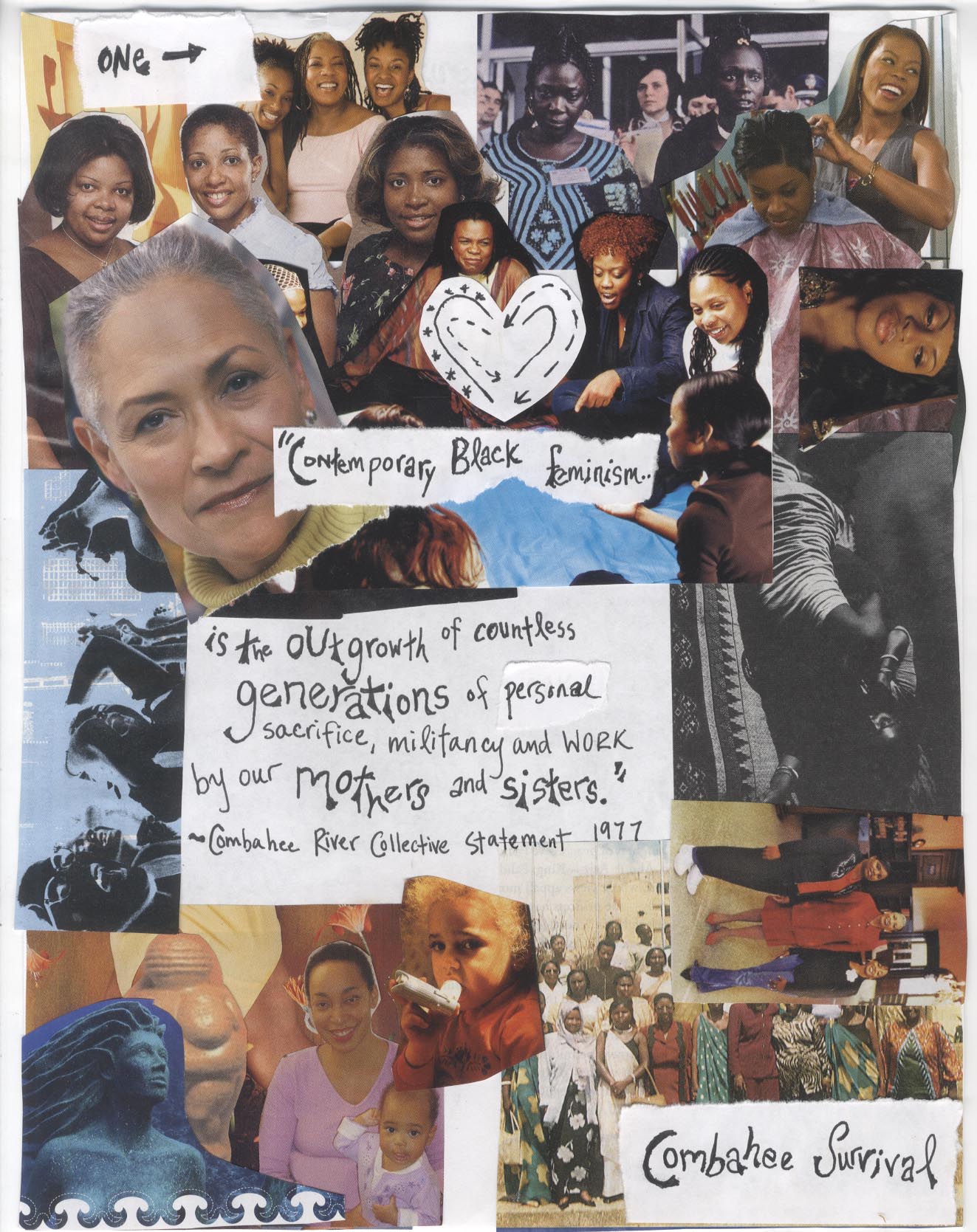
We were never meant to survive. None of us. We were never meant to find each other, love each other, remember the warriors that came before. We were never meant to know these histories. We were never meant to turn our trauma into a map for transformation. We were never meant to survive. But we do it anyway.
Break it down. Sur viv al. Life underneath waiting to embrace all of us. Survival is a poem written in a corner, found waiting in a basement, forgotten. Survival is when the timeliness of your word is more important than the longevity of one body. Survival is spirit connected through and past physical containers. Survival is running for your life and then running for Albany city council without consenting to the State. Survival is shaping change while change shapes you. Survival means refusing to believe the obvious. Survival means remembering the illegal insights censored in the mouths of our mothers. Survival is quilt patterns, garden beds. Survival means growing, learning, working it out. Survival is a formerly enslaved black woman planning and leading a battle that freed 750 slaves from inside an institution called the United States Military. Survival is out black lesbians creating a publishing movement despite an interlocking system of silences. Survival is a group of black women recording their own voices, remembering a river, a battle, a warrior and creating a statement to unlock the world. Survival is like that.
We were never meant to survive. And we can do even more. This booklet moves survival to revival, like grounded growth, where seeds seek sun remembering how the people could fly. We are invoking the Combahee River Collective Statement and asking how it lives in our movement now. And the our and the we are key to this as individual gains mean nothing if others suffer.
We were never meant to survive but we will thrive. We want roundness and wholeness, where everyone eats and has time to be creative has time to just be, What tools does it give that are necessary to our survival? What gaps does it leave us to lean into? Black feminism lives, but the last of the originally organized black feminist organizations in the United States were defunct by 1981.
Here we offer and practice a model of survival that is spiritual and impossible and miraculous and everywhere, sometimes pronounced revival. Like it says on the yellow button that came included in the Kitchen Table Press pamphlet version of The Combahee River Collective Statement in 1986 "Black Feminism LIVES!" And therefore all those who were never meant to survive blaze open into a badass future anyway. Meaning something unpredictable and whole.
We were. Never meant. To Survive. And here we are.
And beyond survival, what of that? In 1977 the Combahee River Collective wrote "As Black women we see Black Feminism as the logical political movement to combat the manifold and simultaneuos oppressions that all women of color face." They also said "The inclusiveness of our politics makes us concerned with any situation that impinges on the lives of women, Third World and working people." And they concluded: "If Black women were free, it would mean that everyone else would have to be free since our freedom would necessitate the destruction of all the systems of oppression."
Today we, a sisterhood of young black feminists, mentored in words and deeds by ancestors, elders, peers and babies, assert that by meditating on the survival and transformation of black feminism we can produce insight, strategy and vision for a holistic movement that includes ALL of us. So while this is a project instigated by self-proclaimed (and reclaimed) black feminists, our intention is that it can be shared and changed by everyone who is interested in freedom.
Check out the exercises, form a study group, and contribute to the Combahee Survival Zine at www.combaheesurvival.wordpress.com!
Thursday, July 31, 2008
Enough!
Hello loved ones!
I think this is a great opportunity to engage in the much-needed and not so often had conversation about class within progressive movements. As I've told many of you...I believe that radical cross-class alliances are what it will take to effectively resist and dismantle capitalism forever. So let's go! I look forward to your comments, responses, and essays to be published in the near future.
much love,
lex
p.s. I have an article in here about the "Pedagogy of Debt"...let me know what you think!
Dear friends,
After much excited brainstorming, dialoguing, essay soliciting, and teaching ourselves basic web skills, we are thrilled to announce the official launch of a new website: ENOUGH!
ENOUGH is a space for conversations about how a commitment to wealth redistribution plays out in our lives: how we decide what to have, what to keep, what to give away; how we work together to build sustainable grassroots movements; how we challenge capitalism in daily, revolutionary ways.
We want this site to be a space for conversation, inspiration, and the creation of ideas. Please read, comment, send us thoughts, submit essays, and join the conversation!
Tyrone Boucher and Dean Spade
www.enoughenough.org/
Friday, July 25, 2008
The Forced Poetics of Black (Feminist) Publishing: Toni Morrison as Editor


This is the text of an essay my sista Zach is reading outloud on my behalf at the Toni Morrison Society Conference this weekend in Charleston, SC.
note:
Think about it. Have you ever had a chosen sister so who could co-write you a dictionary for the secret language of yes? Someone who lives in the growing part of your heart, reciprocally, so if I’m in Durham, she’s home, and if she’s talking to you I’m in your face? A sister true, so honest, so open and priceless that your brainwaves match her breath control even in front of strangers? Did you know it was possible to enjoy a faith that exceeds the limits of one body, because look. It’s happening. Now.
(Please email Alexis Pauline Gumbs at apg5@duke.edu with feedback or inquiries about this paper. And don’t blame the messenger for any shortcomings.)
I.
May we open with an artifact?
On October 27th 1975 Toni Morrison wrote a letter to June Jordan, the poet, on behalf of Random House, the publishing company, in regards to the possibility of publishing her poems:
“The answer they gave was ‘we would prefer her prose---will do poetry if we must.’ Now I would tell them to shove it if that were me—and place my poetry where it was received with glee. But I am not you. Nor am I a poet.”
Toni Morrison is not a poet. One thing that Toni Morrison learned in her many years working for New York City’s Random House publishing company was that the economy of publishing in the United States was in no way random. Especially not when it came to race. Despite her intimate knowledge of the constraints of the mainstream publishing, as an editor Toni Morrison made miracles. She words that were never meant to survive a way through to the future. Many of these have been the words I needed to survive up to this moment. The Library of America edition of James Baldwin’s Collected Essays, Toni Cade Bambara’s post-humously published novel (These Bones Are Not My Child) and short stories (Dream Sightings and Rescue Mission). It was Morrison, before she even published her own first novel, who pushed Ntozake Shange and Alice Walker into print. Often the difference between whether a particular book is or is not is print is literally whether or not Toni Morrison got involved. Without the diligence, strategy and vision of Toni Morrison there is no reason to think the category “Black Women Writers” would be teachable or even imaginable in the literary field.
Sometimes the depth and tactility of the worlds Toni Morrison creates in her novels lead me to believe that she is god. Such a conclusion would be unfair, to Morrison and to the rest of us, but it is fair to assert that Toni Morrison is and has been a major force in the world of black women’s publishing, and black publishing generally in the United States. This paper uses Morrison’s role as a key figure to focus an examination of two broad problems in the project black publishing oriented toward freedom: the problem of poetry and the problem of profit.
II.
(Black) Poetry is a problem in the American publishing market. (Publishing is a problem in the black market of poetry.) So I find Martinican theorist Edouard Glissant’s concept of forced poetics a useful analytic through which to examine the problem of poetry in the American market. For Glissant, the dilemma of the situation of forced poetics is a result of oppression. Everything the oppressed person says, in the language of their oppression, reproduces the situation of oppression because it comes from that same situation. Poetic right? In other words nothing we say is actually free from oppression, because we who are speaking are still oppressed. Even our mouths, our hands and the words we choose to toss towards one another.
I would argue that on the level of publishing, within a market, this is even more pervasive. How, in a capitalist market could you possibly publish something that does not consent to a capitalist system (even while appearing not to)? How in a dominant society that presumes and benefits from the unfreedom of black people could you publish poems by or for free black people?
June Jordan, the same difficult to publish poet we began with, had some ideas about this problem. In her essay “The Difficult Miracle of Black Poetry in America or Something Like a Sonnett for Phillis Wheatley” June Jordan illustrates the paradox thusly
“A poet is somebody free. A poet is someone at home.
How should there be Black poets in America?”
Elaborating on the impossibility of black poetry in a country that enforces illiteracy and homelessness for black people, June Jordan describes the existence of black woman poet Phillis Wheatley as a miracle. And if publishing a book of poems as a slave was difficult, Jordan mentions Wheatley’s lost second book of poems to assert that it would have been even harder to publish the poems of an independent black woman than to publish the poems of a slave.
Jordan says “I believe no one would have published the poetry of Black Phillis Wheatley, that grown woman who stayed with her chosen Black man....From there we would hear from an independent Black woman poet in America.
Can you imagine that in, 1775?
Can you imagine that today?”
What is June Jordan suggesting? Hold this in your imagination for a moment because I think it might be true.
The poems of the enslaved are easier to sell than the poems of the free.
And that’s if you can sell poetry at all. In Toni Morrison’s letter to June Jordan, the poet, she explained that the rejection of June Jordan, the poet, as a poet by the very strategic Random House was based on (quote) “a rudimentary capitalistic principle” prose is a commodity that can be sold, poetry, is something else. I agree with Random House on the distinction that they make between narrative form and poetry. Stories, novels and essayys as mind-expanding, affirming transformative and beautiful as they may be when in the hands of someone like Toni Morrison are still, contained when compared with poetry. Sylvia Wynter (yet another Caribbean theorist) defines the “poetic” as the way we create a world by trying and failing to describe a human relationship to an environment. Poetry is an unwieldy product because it never quite stops being a process. Poetry, as Sylvia Wynter defines it, is dangerous to capital because it challenges the presumption that human beings are related to each other and to their environment through a means of production, and through access to commodities. Poetry, thus defined, says maybe I’m related to you through a process of creation. Maybe we can’t buy or sell each other, maybe the fundamental shape of our relationship is the way my words fit in your mouth. Or vice versa. Who is Phillis Wheatley? What is black poetry after slavery?
How do you sell poetry by poets if a poet is a person not for sale?
III.
And who would you sell that poetry to anyway? The problem of profit in the mainstream publishing market is a primary determining factor in which books stay in print and which words become inaccessible to the future. How then, could one possibly be accountable to an audience of the rare, marginalized, silenced, undertaught, criminalized people we love? To be blunt: Is it possible to publish anything on a widescale in the United States that is not ultimately for white people with access to education and disposable book-buying money? Who cares if I have something to say to you?
In 1977 only two years after Toni Morrison’s realist letter to the poet June Jordan, the two writers were part of a New York based group of black women writers called the “Sisterhood” along with Alice Walker, Ntozake Shange and many others. These women envisioned an autonomous black women’s publishing initiative that would have been called Kizzy Enterprises. Kizzy Enterprises, which Ntozake Shange offered to house, in her house was intended to be a not for profit black publishing enterprise, which would keep important black texts in print, publish a periodical targetted to the black working masses and be supported, not by sales, but by the contributions of like-minded people. According to the minutes taken in the Sisterhood planning meetings for Kizzy Enterprises Toni Morrison made it very clear that none of the plans for Kizzy should be mentioned to Random House. Evidently Morrison understood black non-market publishing to incompatible with a mainstream publishing market in which she was still struggling to support black women writers. In the end Kizzy Enterprises was never born. A friend of ours asked Ntozake Shange about it the other day and she barely remembers the idea. I would never have known about it if June Jordan hadn’t kept the meeting minutes and if Harvard hadn’t kept June Jordan’s files. Kizzy remains an idea haunting the black presence in the literary market which remains determined by mainstream publishing interests.1
Somethings are never meant to survive. And sometimes they do. Because look at what is happening now. I choose to read this history as evidence that autonomous publishing oriented towards freedom is something that is still making. Among other reasons, this is because despite what she has to say, Toni Morrison is a poet.
May we close with an artifact?
In May 1985 Toni Morrison wrote an essay for the 15th anniversary issues of Essence Magazine. Cheryll Y. Greene, a genius and warrior who fought to publish towards freedom in the very confining pages of this black fashion and beauty magazine, created a Celebration of Black Womanhood, for this anniversary issue of Essence and asked Toni Morrison to provide some last words. Toni Morrison the poet addressed June Jordan retroactively and all of us with these last words and now we address her too:
“You had this canny ability to shape an untenable reality, mold it, sing it, reduce it to its manageable, transforming essence, which is a knowing so deep it’s like a secret. In your silence, enforced or chosen, lay not only eloquence but discourse so devastating that “civilization” could not risk engaging in it lest it lose the ground it stomped. All claims to prescience disintegrate when and where that discourse takes place. When you say “No” or “Yes” or “This and not that,” change itself changes.”
Thank you.
Monday, July 14, 2008
the half: (to alexis, in flight)
(made out of an in-flight magazine
on the way home from NYC
on the artist's 26th birthday)
1. Grow
Crazy, wild and crooked as you want to be.
Your roots in this vision are deep.

2. Look up.
Your faith in yourself
is the bridge to where you're going.
on the artist's 26th birthday)
1. Grow
Crazy, wild and crooked as you want to be.
Your roots in this vision are deep.

2. Look up.
Your faith in yourself
is the bridge to where you're going.

3. Don't be ashamed of crying
The seeds of your freedom
need are
water thirsty
 4. Remember what peace looks like.

5. Read your dream close.
Touch them
trail them
like maps
to who you already are.

6. SCREAM
IF YOU
GOTTA

7. Raise ancestors
like babies
in your gut.

8. It's NOT one of these.
 9. Reflection is soul.

10. some gifts are traps
and vice versa

11. know when
to bend and when
to break.
to bend and when
to break.

12. Play on.

13. you
know
know

Wednesday, July 09, 2008

Thursday, July 03, 2008
Too Important or What We NEED: Transformation in the Face of Violence and Silence

"I wrote it because I wanted to talk abut blackwomanslaughter in a way that could not be unfelt or ignored by anyone who heard it with a hope perhaps of each one of us doing something within our immediate living to change to change this destruction."
"We are too important to each other to waste ourselves in silence."
- Audre Lorde in a prefatory essay to Need: A Chorale for Black Woman Voices
In 1979 Barbara Smith sent Audre Lorde a news clipping via snail mail. Yet another black woman in her community in Roxbury had been found dead. Over these four months, during which 12 black women were killed in the black nieghborhods of Boston, black feminists, led by black lesbian feminists built a coalitional movement to respond, using public art, poetry, self-defense, publishing and political education. Barbara Smith and Lorraine Bethel were editing what would become the foundation black feminist collection, Conditions 5: The Black Women's Issue. Audre Lorde wrote Need: A Chorale for Black Woman Voices in response to this wave of murders. The energy and analysis forged in the words and promises exchanged between black feminists at that moment grew into a broad movement that lives, waiting and growing in those of us hungry for the words that were never meant to survive.
This past Monday, not yet 30 years after Barbara Smith's letter to Audre Lorde, Moya sent an email with a link to a news story:
http://abclocal.go.com/wpvi
This woman is black
so her blood is shed into silence.
A building full of neighbors heard the screams of this survivor while she was being sexual assaulted in her home, but were at a loss to actually act against this violence in their community. They didn't know how to respond, they didn't want to believe what was happening. So they kept their doors closed. They went to sleep.
This story is important for a number of reasons. As Moya points out it is yet another instance of silence within the black community about violence against a black woman coming on the heels of Megan Williams, Dunbar Village, R. Kelley's Acquittal and more. This is what breaks our backs.
I also think this story, literal silence in the moment of violence, is important for what it demonstrates more generally. Our silence, as oppressed communities about the gendered violence that disproportionately impacts our communities is glaring, harmful, devastating. We generally really feel that in a racist police state, and individualist capitalist state, a fear-filled falling apart place we don't have the resources to respond to violence even when we hear it happening, on the news and in our buildings every night.
But if we have each other, we do have what we need to take care of each other, hold each other accountable, keep each other safe and whole. If we have each other we do.
And I say, thank the Lorde, we have in Need a resource for transformation and a means to open us these impossible conversations about the real costs of gendered violence in our communities. The task of the poet is to say the unsayable, and Audre Lorde, may she never be forgotten, literally gives us the tools to open our mouths.
The UBUNTU Artistic Respons committee which convened in Durham, North Carolina in the midst of the Duke Lacrosse Rape Case, used Need (in addition to other poems and the documentary NO! by Aishah Simmons) to break open rooms of people and to instigate real discussions about the impact of gendered violence against black women WITHIN black communities, at the hands of other black people.
When my father, a person professionally trained and personally prone to debate and argument read Need he had no arguments to make. He told me that reading the piece was simply a moment in his education. He compared it to a moment in high school when he watched a film that documented all the shaven hair, all the bodily ashes, all the teeth and bones of the victims of the Nazi holocaust. He said that a mass of violence, an unimaginable horror had become visible and real to him in Audre Lorde's words. He said there was no question about whether this was true, whether it was relevant, whether it impacted him. He said now I know. The only question is what we do.
This is the Summer of Our Lorde, when we transform silence into action and power. I want to ask us to read and share Need available for download via:http://letterstoaudre.wordpress.com/need-end-violence-against-women-of-color-now/
with everyone we can share it with. Let us read it with other women in our communities, let us print our copies and give them to our families. Let us build a fire of healing that can ignite our communities into the conversations we need in order to build the trust, connection and analysis that we need to work together for survival, safety and love in our communities.
love always (in the hands of Audre),
lex
Subscribe to:
Posts (Atom)


 Posts

